Set Date(s)
c. 1944
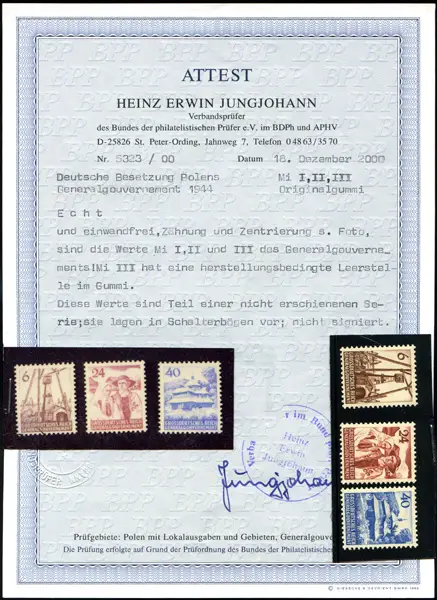
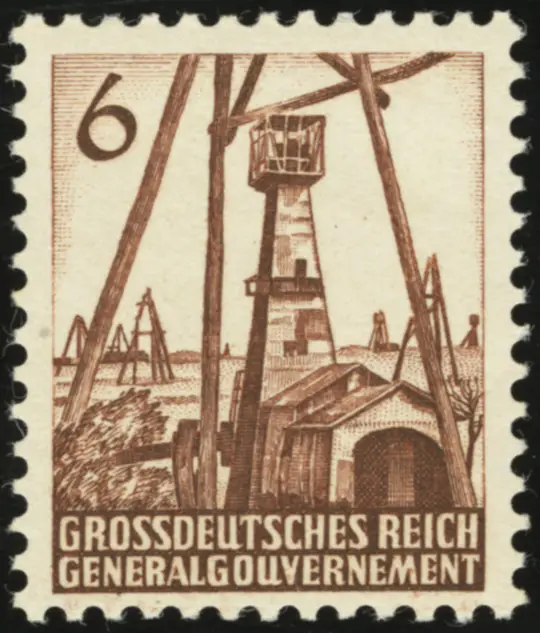 MiNr. I
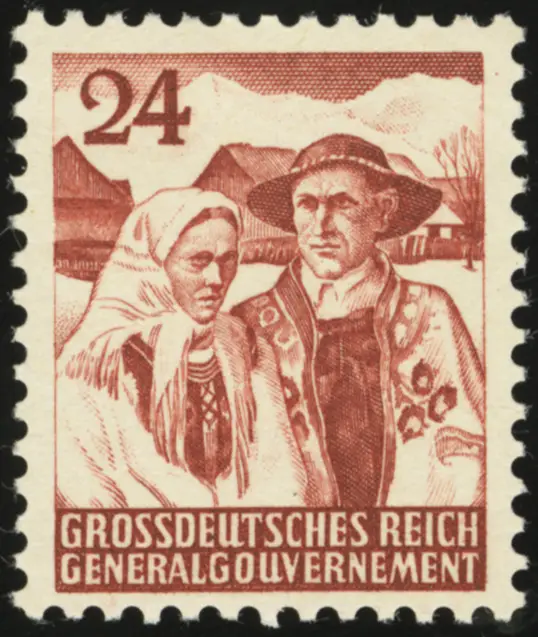 MiNr. II
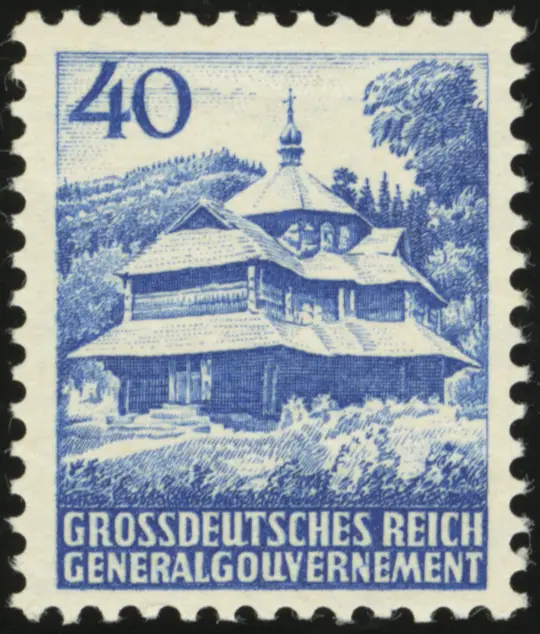 MiNr. III
These stamps were the first of a 10- to 17-stamp series depicting the Land and People of the area, and intended to replace the prior Hitler definitives. However, with the fall of the Generalgouvernement to the Red Army, the design of the full stamp series was never completed, and those designs that had been printed were never issued.
This series is sometimes referred to as the “Górale” or “Goral” series, after the Goral couple in the 24 Gr. issue.
After the war, they entered the collecting market from the printing works in Vienna.
The stamps depict:
Numerous color proofs exist, as well as a proof copy of a 12 Gr stamp (MiNr. A P1) depicting a Wagon.
MiNr. I
MiNr. II
MiNr. III
These stamps were the first of a 10- to 17-stamp series depicting the Land and People of the area, and intended to replace the prior Hitler definitives. However, with the fall of the Generalgouvernement to the Red Army, the design of the full stamp series was never completed, and those designs that had been printed were never issued.
This series is sometimes referred to as the “Górale” or “Goral” series, after the Goral couple in the 24 Gr. issue.
After the war, they entered the collecting market from the printing works in Vienna.
The stamps depict:
Numerous color proofs exist, as well as a proof copy of a 12 Gr stamp (MiNr. A P1) depicting a Wagon.