
Menu
Weimar Republic

Set Date(s)

23 December 1922
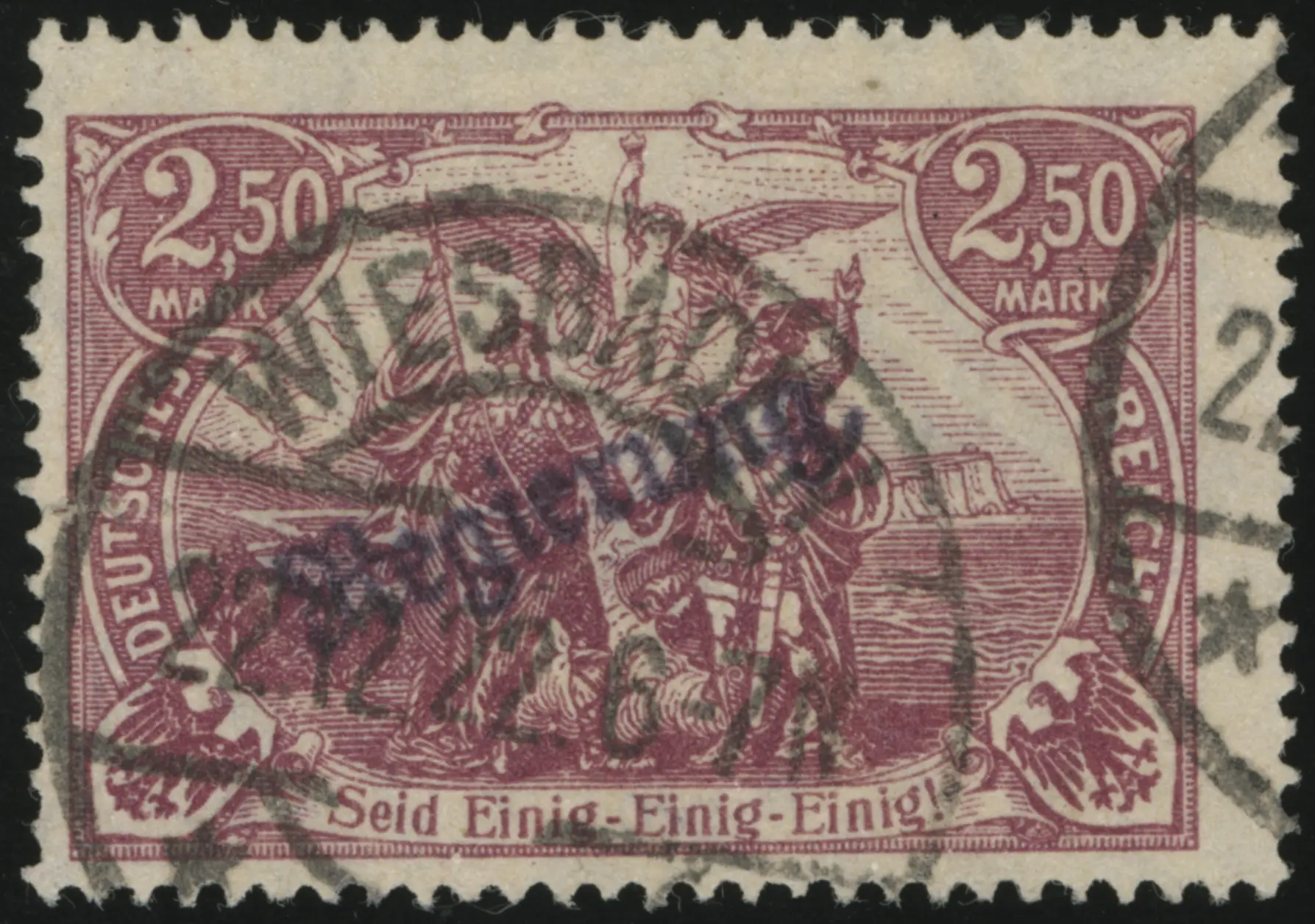
Control Overprints – Wiesbaden
With the rising hyperinflation in late 1922, it became difficult for German government offices to maintain stocks of official stamps with sufficient face value to meet the rising postage rates. As a result, German government offices were authorized to use normal postage stamps for official purposes. In order to prevent misuse or pilferage of the its stocks of normal postage stamps, the senior government official in Wiesbaden secured permission from the Frankfurt am Main OPD to have an overprint applied to the normal postage stamps, in much the same way official stamps frequent bore an official overprint.

The overprint applied to the Wiesbaden stamps bears the word “Regierung”, or “government”, and can be found in three types, with Type II being the most common and Type III the rarest.


Type I – 17.5 mm wide
Type II – 22.5 mm wide
Type III – 28 mm wide

In addition, 4 ink colors are known:

  • “a” suffix – violet black
  • “b” suffix – red
  • “c” suffix – green
  • “d” suffix – violet

Not all values can be found in all 4 colors.

25 different stamps are known to have been overprinted, in a mixture of ink colors and overprint types.  The total number of currently known combinations of is approximately 137.

Control Overprints – Wiesbaden
With the rising hyperinflation in late 1922, it became difficult for German government offices to maintain stocks of official stamps with sufficient face value to meet the rising postage rates. As a result, German government offices were authorized to use normal postage stamps for official purposes. In order to prevent misuse or pilferage of the its stocks of normal postage stamps, the senior government official in Wiesbaden secured permission from the Frankfurt am Main OPD to have an overprint applied to the normal postage stamps, in much the same way official stamps frequent bore an official overprint.

The overprint applied to the Wiesbaden stamps bears the word “Regierung”, or “government”, and can be found in three types, with Type II being the most common and Type III the rarest.

Type I – 17.5 mm wide
Type II – 22.5 mm wide
Type III – 28 mm wide

In addition, 4 ink colors are known:

  • “a” suffix – violet black
  • “b” suffix – red
  • “c” suffix – green
  • “d” suffix – violet

Not all values can be found in all 4 colors.

25 different stamps are known to have been overprinted, in a mixture of ink colors and overprint types.  The total number of currently known combinations of is approximately 137.

Set Date(s)

23 December 1922